
What is organisational culture?
Culture in an organisation means how people do things repeatedly, consistently, observable patterns of behaviour. (Watkins, 2013) How people feel, think or believe. It also focuses on the forces that shape organisational behaviour. The outcome of this is ethics, how they make a decision, and how they operate the organisation.
The organisational culture may decide trends of organisation, such as the culture in which most people tend to ignore the issues in the organisation, it will be a culture of inaction. And in the future become a standard of human behaviour in that organisation. The pattern of organisational behaviour that emerges from a corporate culture can either be a supporting factor or an obstacle to the operation of the organisation, especially the decision to solve issues. Culture affects the form and content of general-person relationships within the organisation.
About Pinterest
Pinterest, Inc. is an American social media company. The company was founded by Ben Silbermann, Paul Sciarra, and Evan Sharp in December 2009. (Meng, 2019) It is a social network platform using a pin to bookmark their online content. Pinterest has 300 million active users per month as of August 2019. (Fiegerman, 2019) Pinterest is available in more than 27 languages. It makes money by digital advertising market competing with Facebook, Instagram, Google and Amazon. The company grow slower than all of its competitors in the industry.

The culture of Pinterest is far away from all its competitors in the social media industry, where they actively encourages their employees to confront and debate. For example, the CEO of Amazon asked employees to “disagree and commit” which means, employees are welcome to disagree, but when they made a decision, they have to do their best to achieve it. (Weise, 2017) Pinterest has always wanted to be a different company. Kent Buller, one of the Pinterest’s manager until late 2017, said “They wanted it to be truly progressive. As long as you focus on your business goals, we will make a world-class experience.” (Rodriguez, 2019) This provides a culture where people can do meaningful work without anyone being in disagreement. But the philosophy sometimes backfired.
Problem with Pinterest
Pinterest seeks up to $9 billion in valuation, $3 billion different from their expectation of $12 billion in 2017. (Walko, 2019) The company shows slow growth but steady: It has $756 million for its revenue in 2018, up 60% from its previous year. However, early investor, Andreessen Horowitz, expected $2.8 billion as he said in 2015 presentation. From the interviews of Pinterest’s staff at many levels, they shared some experiences working in the company. It reveals situations where a lack of clear input and quick decision-making contributed to employee turnover and strategic errors.
The consequences of being so nice
Meetings at Pinterest were always full of complement, but no direct feedback was given. They usually arrange more meetings. Positive feedback will be delivered directly, but the negative one will be shared privately. This causes the company to take a misstep and make it slower to make a decision.
What makes the perfect team?

The answer could be found in defining its characteristics (Mullins, 2016):
- A belief in shared aims and objectives
- A sense of belonging to the group
- Acceptance of group values and norms
- A feeling of mutual trust and dependency
- Full participation and consensus in decisions
- A free flow of information and communication
- Open expression of feelings and disagreements
- Conflict resolved within the group
- Low levels of staff turnover and absenteeism
This phenomenon is not good according to the characteristics of a perfect team which is the open expression of feelings and disagreements, to keep sharing feedback for each other (Mullins, 2016). The company should insist on all employees to be more open, discussing their opinions and even disagree sometimes. This dynamics will help the company to get direct feedback and can make the right decisions quickly.
The organisational iceberg
Culture is seen as the recognisable values and behaviours within an organisation; influenced by the rewards the workplace policies and environment, and the identity and value of the company. All of these are part of the culture. But like an iceberg, most of what drives behaviours within the organisation are unseen and completely hidden far below the surface of what anyone in your company consciously thinks about. (Rick, 2014)
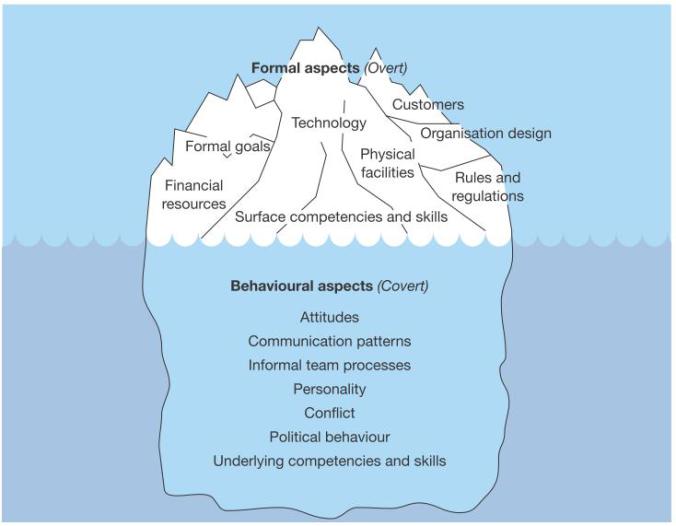
Despite the underlying conflicts in the communication pattern and the employees’ “too-nice” attitudes, Pinterest is still performing well, which implies the company’s steady revenue growth. It shows a significant increase of 60% compared to its previous year and reaching up to $756 million in 2018. This indicates that the behavioural aspects of the company have not shown any impacts to its formal aspects. Nonetheless, if no measures are taken to cope with the issues, it will undoubtedly tremble the whole business’ stability and threaten its sustainability.
Look closely.
When looking closely onto the problem at employees level, it can be explained by the Johari Window. It is the model which describe the relationship and mutual understanding between members of the group (Loschinin, 2015).
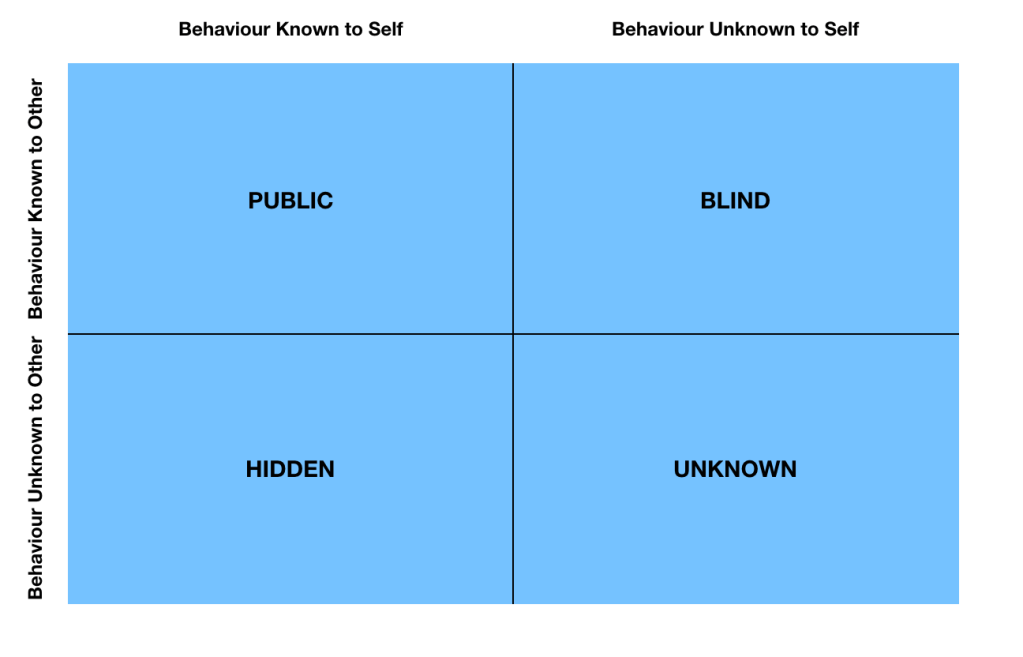
From this diagram, employees at Pinterest might have massive hidden behaviour. This shows the state of an individual known to him but not known to the others. These employees are introvert and do not like to share their feelings, ideas or thoughts to anyone. That makes it hard to find the mistakes in the company and to make the right decision since their employees do not open up enough.
What is next?
There are several improvements needed to do within Pinterest’s organisational culture. To move forward quicker, every employee must open up enough to each other, disagree sometimes and share their idea to improve their organisation. To do that, all the managers level in the company must show how important the disagreement is. That is how they can improve their organisational culture. These will help the company to find the mistake and fix it in time. Then the company can move to the right direction and accomplish the target profit that they hope.
References are on the next page.
 Fluke Pongsakorn
Loved this Fluke !
How about a task culture in Pinterest, if they ever apply it, how will it affect the employees ?
LikeLiked by 1 person
Thanks Christelle. The employees will be formed in to a team base on their task to achieve the targets or solve problems. It will be better for the company since they can achieve the goal faster.
LikeLike
Really great blog! Learned a lot about culture!
LikeLiked by 1 person
Thank you Peter.
LikeLike
Hi Fluke,
That was a wonderful blog you have written.
You have put some strong points which is commendable.
I just have one question that is how should be an ideal workplace or ideal organisational culture should look like?
LikeLike
That was a wonderful blog you have written.
You have put some strong points which is commendable.
I just have one question that is how should be an ideal workplace or ideal organisational culture should look like?
LikeLiked by 1 person
Thanks Roohi. For my opinion, it would be like democratic. Everyone can share their opinion or their point of view. That way, the company will have many perspective before making a decition.
LikeLike
Hi,fluke. the definition of culture was introduced in detail, and cases were given for analysis. In addition, various models were combined, The overall thinking was particularly clear, the language was fluent and easy to understand.
It is really a good articl.One question,what are your thoughts on the future of organizational culture?
Well done,learn from you.
LikeLiked by 1 person
Thanks Emma. I think future of organisational culture is Democratic culture. Nowadays, people can access a lot of information via the internet. Everyone has their own thought. They can’t be forced to think in the same way or blindly follow their boss like in the Autocratic culture. I’m not saying that Autocratic is bad. It depends on their organisation.
LikeLike
I like how you elaborate on this topic thoroughly by analysing it through a real company case! As we may know, some companies may have difficulties in implementing this ‘openness’ culture due to its employees’ privacy preference – some may view this transparency as a discouraging act that exposes too much of their private matters. What steps do you think the company should take in order to instill this openness culture to this type of employees?
LikeLiked by 1 person
Thanks Amy. I think the first thing they need to do should be doing with the manager level. If they can show employees that open up is better for both the company and the employees themselves, I think employees will follow what their leader do.
LikeLike
This is a good blog with a useful information. I can learn a lot from this. Please continue doing it. Can’t wait to see the next one.
LikeLiked by 1 person
Thanks Krit. Stay tuned!!
LikeLike
Interesting read. A lot of firms don’t realise the importance of a firm’s culture and its influence on how a firm is run. Some just blindly proceed to its objectives. The organisational iceberg really highlights the value of the behavioural aspects of the firm, well done Fluke!
Would you care to comment on the issues that could arise if a firm’s culture is instead too ‘open’?
LikeLiked by 1 person
Thanks Ban. I think if they are too open, they might have many conflict and misunderstanding within the organisation. So the solution for this case is to open up just a bit more.
LikeLike
A very interesting topic discussing on a rising creative-media business which I’m sure most are on the rise nowadays. If you would classify Pinterest’s culture using Handy’s model, which one do you think would prevail, and why?
LikeLiked by 1 person
Thanks Wardah. I think it would be Task culture since everyone in the organisation are doing their task and be able to make a decision. But the problem is they can’t share their opinion freely.
LikeLike
Good Job Fluke
One question, can you explain more about the consequences of being so nice ?
LikeLike
Thanks Ammar. Because they were too nice to each other, they can’t make a decision fast enough since bad comment can’t be delivered directly. So, I think it would be better if they open up to each other more.
LikeLiked by 1 person
This is very interesting case study about Pinterest. This blog has very useful informations to know about their organisation culture. To look at Handy’s Model of culture, which culture do you think it can be described for Pinterest’s culture now and which culture do you think it would be the best culture for Pinterest to improve their organisation culture?
LikeLike
Thank you for reading. For Handy’s model, I think it would be task culture. Current culture seems fine but just open up a bit more.
LikeLike
Hey, Amazingly written blog. Covering all the theories so well. Helped me in learning a lot about culture and how it can be managed.
LikeLike
Thanks a lot Priyanshi. Glad you like it:)
LikeLike